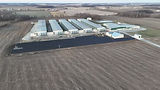
Data centers consume enormous amounts of electricity—often 24/7, year-round. As energy prices rise and grid reliability becomes less predictable, relying solely on utility power exposes operators to financial volatility, capacity constraints, and sustainability pressure. Commercial solar for data centers offers a strategic advantage. Whether installed on-site, on adjacent land, or through a behind-the-meter configuration, solar can offset peak demand, reduce operating costs, and support long-term growth without sacrificing reliability.
WHAT MAKES SOLAR IDEAL FOR DATA CENTERS
Unlike traditional commercial facilities, data centers are uniquely positioned to benefit from large-scale solar deployments.
-
Predictable, Long-Term Energy Cost Control
Solar provides a hedge against volatile utility pricing. With power purchase agreements (PPAs) or owned systems, data center operators can lock in predictable energy costs for 20–30 years—dramatically improving long-term financial modeling.
-
Peak Load Reduction & Demand Charge Mitigation
Solar generation aligns closely with daytime peak demand, helping reduce costly demand charges and lowering strain on grid interconnections during high-load periods.
-
ESG, Sustainability & Client Requirements
Enterprise customers increasingly require clean energy commitments from their data providers. Solar investments directly support carbon reduction goals, ESG reporting, and compliance with sustainability mandates—without relying on offsets alone.
-
Grid Resilience & Energy Security
When paired with battery storage or hybrid energy strategies, solar can enhance redundancy and resilience. This supports uptime objectives and mitigates exposure to grid instability or capacity limitations.
-
Scalable Infrastructure for Growth
Solar systems can be designed to scale alongside data center expansion—supporting additional racks, buildings, or campuses without proportional increases in grid dependency.
FINANCIAL MODELS THAT WORK FOR DATA CENTERS
JK Renewables structures solar solutions around the financial and operational realities of data centers:
-
Direct Ownership: Maximize ROI, depreciation benefits, and tax incentives.
-
Hybrid Models: Combine ownership, PPAs, and storage for optimized performance.
-
Behind-the-Meter Systems: Offset internal consumption and reduce utility exposure.
Our team evaluates each site based on load profiles, land availability, interconnection constraints, and long-term expansion plans.
OPERATIONAL IMPACT (LOW MAINTENANCE, HIGH RELIABILITY)
Solar systems require minimal ongoing maintenance and are managed proactively through performance monitoring and preventative service programs. Once installed, the operational burden on your internal teams is low—while the financial and environmental returns continue for decades.
Is Your Data Center a Good Fit?
Not every site is the same—but data centers with the following characteristics are strong candidates:
-
High, consistent electrical load
-
Available roof space, parking structures, or adjacent land
-
Long-term operational horizon
-
Rising utility costs or constrained grid capacity
-
Corporate sustainability or carbon reduction targets
If your facility meets even a few of these criteria, commercial solar could deliver immediate and long-term value.

Next Steps
Power Your Infrastructure with Confidence
Interested in exploring how commercial solar could support your data center’s financial performance, resilience strategy, and sustainability goals? JK Renewables provides end-to-end analysis, design, financing, and deployment—tailored specifically for data-intensive operations.
-
Reduce long-term energy costs
-
Improve ESG performance
-
Enhance energy resilience
-
Support scalable growth
Let’s take a closer look at the benefits.
1. Passive, Long-Term Income
Leasing your land for a utility-scale solar project can bring in guaranteed annual income for 25–40 years. In many cases, solar developers handle the construction, permitting, and operations—you simply provide the land and enjoy a consistent revenue stream. Alternatively, some landowners choose to co-invest or partner in the project, increasing their long-term returns even further.
2. Low Maintenance, Low Risk
After installation, solar farms require minimal upkeep compared to agriculture or traditional development. Operations are typically managed by the solar provider, meaning you won’t be responsible for day-to-day maintenance. And because solar is a proven, growing sector with strong policy support, it offers a relatively low-risk investment with dependable returns.
3. Enhanced Land Value
Turning your land into a solar site can significantly boost its economic value—especially if the land isn’t currently producing income. Dry, non-agricultural, or remote land that might not be ideal for other uses is often perfect for solar development. In some cases, land that’s been sitting idle for years becomes a high-yield investment with almost no physical disruption.
4. Energy Independence for the Community
Utility-scale solar doesn’t just benefit your wallet—it can also provide power to local homes and businesses. By helping bring clean, reliable electricity to your area, you're contributing to local energy independence and resilience. If your land is in a rural or underserved area, this can be a meaningful contribution to the community’s infrastructure and economic development.
5. Job Creation and Economic Growth
Hosting a utility-scale solar project means supporting local job creation—everything from construction crews to long-term maintenance staff. Many projects prioritize hiring locally, giving a direct economic boost to your region. That means your land is helping to create employment, stimulate the local economy, and support the transition to clean energy.
6. No Impact on Water Resources
Traditional energy systems require vast amounts of water for cooling. In contrast, solar farms use little to no water during operation. If you live in a water-scarce region or care about preserving local water resources, solar is a great low-impact option. Plus, the lack of water use reduces environmental strain and operating costs—making it even more attractive for developers and investors.
7. Environmentally Responsible and Sustainable
Leasing or developing your land for solar is a powerful way to reduce greenhouse gas emissions. Unlike fossil fuel-based power, solar energy doesn’t emit CO₂ or toxic pollutants. You’ll be playing a direct role in fighting climate change and protecting the environment—without sacrificing returns.
8. Future-Proofed Investment
Sunlight is a renewable resource that isn’t going away. With proper infrastructure, a solar installation can generate clean energy—and income—for decades. You’re not just investing in the present; you’re securing long-term value for yourself, your family, and even future generations.

If you operate a data center, energy isn’t just a cost—it’s your largest operational risk and your greatest opportunity. Commercial solar solutions designed specifically for data centers can dramatically reduce long-term energy expenses, stabilize power pricing, improve ESG performance, and support uptime resilience. JK Renewables specializes in high-capacity, commercial solar systems engineered to integrate seamlessly with mission-critical infrastructure.